
Contents
1 Lloyd’s Register Group and Lloyd’s Register Foundation appoints Matthias Altendorf as new chair
2 Launch of the Heritage Centre Website
3 Acquisition of the Frank Strike Collection
4 The records of the Furness Shipbuilding Company
8 All hands on deck: Securing the maritime future through diversity
Welcome
Alex Stitt
Director of Heritage, Lloyd’s Register Foundation
We are now halfway through 2026, and it has already been a landmark year for the Heritage Centre. From the appointment of incoming chair Matthias Altendorf to the launch of our new Heritage Centre website, there has been plenty to celebrate. We have also opened our first Heritage Open Call, making £2.5 million in grant funding available to support new research and activity across the sector.
Best Wishes,
Alex
Lloyd’s Register Group and Lloyd’s Register Foundation appoints Matthias Altendorf as new chair
Matthias Altendorf will succeed current chair Thomas Thune Andersen when he leaves the role at the end of his tenure in June 2027.
Matthias Altendorf, 59, brings a wealth of experience as both an executive and non-executive director across a number of high-profile organisations. He enjoyed a distinguished career of almost four decades with the Swiss-based Endress+Hauser Group, including serving as CEO from 2014 to 2023 and subsequently chairing its Supervisory Board.
Beginning his career as a toolmaking apprentice, Matthias worked his way through the organisation to lead the global, family-owned engineering business specialising in process and measurement technology – helping clients to ensure precision, quality and safety in the products they manufacture. This included the shipbuilding, and both offshore and onshore markets where he was a strong advocate of digitalisation and connected solutions. Through that experience, he brings to LR’s Power of Three proposition a combination of industrial leadership, digital expertise and customer focus that strengthens its ability to connect class, digital and advisory capabilities across vessel, voyage and people.
He is also the founder of Bionic Leadership, a company which focuses on developing human-centred management to pioneer evolutionary approaches to leadership and economic social systems.
Commenting on his appointment, Nick Brown, Chief Executive Officer of LR, said: “I am delighted to welcome Matthias to LR. He brings with him a record of truly inspirational global leadership.
Matthias’ vast and varied experience will be a tremendous benefit to LR.
“Matthias’ vast and varied experience will be a tremendous benefit to LR as we continue to develop and evolve our services to meet the needs of our clients and colleagues across an ever-evolving maritime industry.
Matthias Altendorf said: “As the incoming Chair of Lloyd’s Register Group and Lloyd’s Register Foundation, I feel both humbled and energised by the trust the Trustees have placed in me. Lloyd’s Register is an institution with a rare clarity of purpose, combining technical excellence, independent governance and a deep commitment to making the world safer and more resilient. To be invited to help steward such a legacy setup is a profound honour.
“What inspires me most is the unique combination of scientific depth, public purpose, entrepreneurial responsibility and global impact that define both Lloyd’s Register Group and Lloyd’s Register Foundation. Few organisations manage to serve industry and the public good with such coherence and conviction.
“I look forward to contributing to this mission by honouring the past, strengthening the present and helping to shape a future in which Lloyd’s Register continues to serve society with clarity, courage and responsibility.”
Ruth Boumphrey, Chief Executive of the Foundation, said: “We’re very much looking forward to Matthias joining us. His experience and passion for social purpose and placing people at the heart of wide-reaching transformations is very much aligned with the work of the Foundation.
“We are certain we will benefit greatly from his knowledge and expertise as we continue to deliver our mission to engineer a safer world.”
We are certain we will benefit greatly from his knowledge and expertise as we continue to deliver our mission to engineer a safer world.
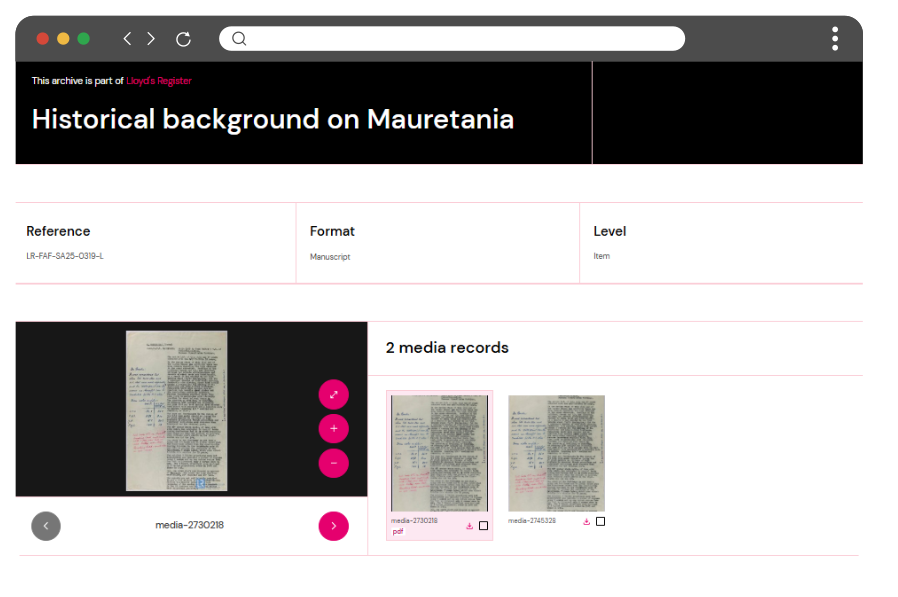
After a year of work behind the scenes, we’re excited to share the launch of the new Heritage Centre website.
The upgrade has transformed how visitors can explore and engage with our collection of maritime records and stories – an unparalleled reserve of knowledge on the evolution of maritime safety. It is the exciting next step in our mission to help others learn from the past for a safer and more sustainable ocean economy in the present.



What has changed, and why?
The Heritage Centre has a fully redesigned website, with an advanced search system covering the 1.3 million+ historic maritime records – an unparalleled reserve of knowledge on the evolution of maritime safety. The navigation has also been upgraded, with users now able to move from broad themes to specific items quickly, explore improved content pages, and access new research guides that offer context, tips, and links to digitised material. Whether you’re arriving with a specific question or simply curious to browse, the new Heritage Centre website is designed to help you get to the material that matters – quickly.
From homepage to record in a few clicks
The collection search can now be reached directly from the new homepage, with major collections pinned for quick access. This delivers quicker, clearer routes to digitised collections, register book e-readers, and research and information guides. Other features include highlighting popular pages so new visitors can see what others are reading, and a place to showcase the latest updates from our partner work with the collections and our funding.
Navigation built around real user journeys
Thanks to consultation with users, we have clarified the menu and sub-sections so visitors can move more quickly through the site, as well as introducing an optional light/dark mode for improved accessibility.
Powerful search across 1.3 million+ records
The new collections page brings together full search functionality and clear routes into digitised collections. Key features include:
- Smarter results: records display key information depending on what you’re looking at (for example, vessel build year and vessel ID for vessel records).
- Archive hierarchy you can navigate: grouped records make it easier to understand where an item sits within a collection.
- Readable library entries: long titles are handled cleanly, and pages highlight useful, related subjects and authors.
- Better document viewing: for plans and digitised items, you can zoom, go full screen and download.
New research guides to support every kind of researcher
The context of a record is a vital part of modern research, as it is the signposting that helps make sense of a single source. To support this, we have created new research guides, each of which offer new visitors and experienced researchers clear navigational tools in a consistent, easy to-scan format.
They include:
- Clear overviews of the topic and where to start.
- Key relevant collections (including reference codes where helpful).
- Links to digitised material and related resources.
- Practical research tips to support your next steps.
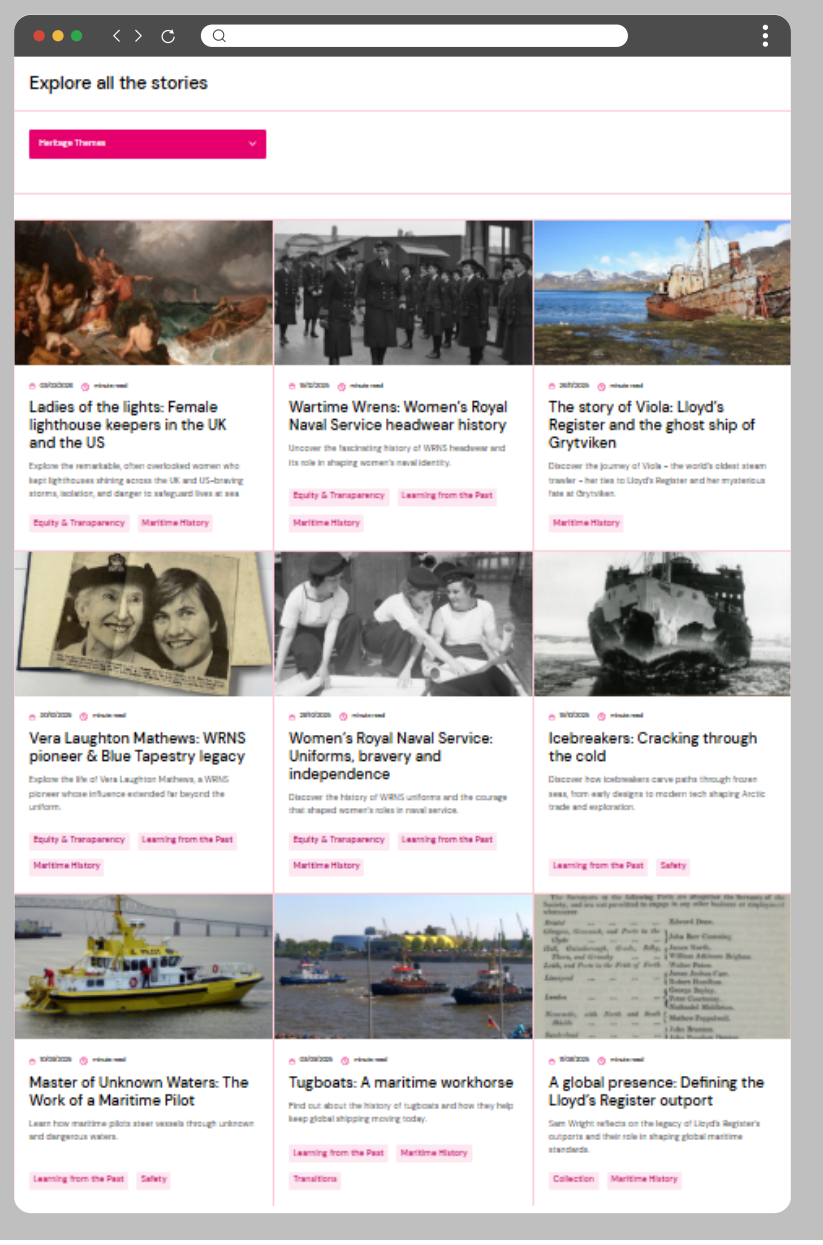
Stories: a visual hub for outreach, programmes and projects
Stories is a new content hub that draws together all our outreach content: flagship programme news, the latest blogs, and routes into exhibitions and major projects.
Acquisition of the Frank Strike Collection
In November 2023, the attention of the Heritage Centre was caught by a BBC article highlighting a unique collection for sale at public auction; ‘hundreds’ of magic lantern slides. The collection itself, gathered and curated by shipbuilder and local historian Frank Strike, features shipwrecks, rescues and salvage operations all conducted along Cornwall’s coastline from 1890s to 1960s.
Offering potentially exceptional insight into maritime technology, safety equipment and ship/yacht building, the Foundation decided to bid and was, thankfully, successful in winning the lot for a total of £15,000. Collected from the auction house at Penzance by the Centre’s Senior Archivist the Lloyd’s Register Foundation officially took possession in December 2023. Since then, a full catalogue of the Frank Strike Collection has been completed and the extent of this fascinating addition to our archives can be fully known and made freely available to the public.
Examples of the annotated magic lantern glass slides found within the Frank Strike Collection.
Magic lantern history and collection contents
The Frank Strike Collection is also notable as the first magic lantern slides to enter the Foundation’s archive. Dating from the first half of the 17th century, magic lanterns, sometimes known as lanterna magica, were a pioneering form of portable image projection that reached the height of its popularity in the 19 th century, declining only with the rise of cinema. Later becoming a fixture of public education, they were originally conceived as a form of entertainment typically enjoyed by the well-to-do and middle classes. They are perhaps most famously associated with the sensational rise of phantasmagoria or horror theatre that would give semi-transparent life to apparitions, skeletons, and other demonic forces that delighted and terrified the general public. They consist of a light source, i.e. a candle or electric bulb, one or sometimes multiple lenses and most importantly, transparent (usually glass) picture slides.
In addition to the lantern slides, the purchased collection also included spare projection bulbs and, crucially, the magic lantern itself, produced by J H Steward of London. Not only have we been able to confirm that the magic lantern is in good working order, but to Frank Strike’s credit, it has also been fitted with a modern UK three-pin adapted plug!
Across five boxes, the newly catalogued collection totals 341 glass magic lantern slides. The majority are believed to have been purchased from the notable Gibson family of photographers, based at Penzance. The other main source appears to have been Alfred Herbert Hawke of Helston, who supplied only photographs, from which Frank Strike produced slides of his own. Though research and cross referencing online shows that the National Maritime Museum holds prints of 48 of the collection’s slides, the rest are believed to be wholly uncopied.
THE RECORDS OF THE FURNESS SHIPBUILDING COMPANY
The Heritage Centre (HC) recently finished cataloguing a collection of deposited records relating to the Furness Shipbuilding Company (reference FSC). These were deposited with the HC by a researcher who had worked at the shipyard prior to it closing in the 1960’s, he gained permission from the shipyard owners to salvage the records when the yard closed and years later deposited them with LR alongside the research that went into a publication on the history of the company.
Following a project to appraise, list and catalogue the Lloyd’s Register Archives in 2022-2024, we also identified other collections deposited with us or acquired by us that remained uncatalogued. Like many archives, we have a backlog of uncatalogued material within our collections and the FSC records were part of this.
The yard was laid down in 1918, north of the River Tees. Viscount Furness pulled together shipbuilder, engineers and naval architects to design the shipyard and it was capable of building some of the largest ships of its time. As a result of fears of lack of a worker force, accommodation and spaces for work and recreation were built near the shipyard to attract workers from around the UK. The keel of the first vessel was laid in May 1918. At the end of the 1920’s they were tasked with building the whale factory ship Sir James Clark Ross, which went to the Antarctic every year of its service from 1930-1967. This ship was classed by Lloyd’s Register, and the surveying and construction records can be found here.
The shipyard underwent modernisation and redesign in the early 1960’s and was finished by 1965. However, the growth of overseas shipyards and shipbuilders and the slowing down of UK manufactured ships led to the FSC closing down in 1968. It was subsequently bought by Swan Hunter who continued to build vessels on the Haverton Hill yard until 1978 when all production was ceased. The last vessel to be built in the shipyard was the New Zealand Star.
Alongside building ships, FSC also provided steel and material for infrastructure and buildings throughout the UK including bridges, gas works, rail supplies and steel platforms for Rail stations.
The groundbreaking project to uncover and showcase the role of women in the maritime sector – past and present – is celebrating India’s leading women change makers.
Now in its international phase, stories and features celebrating women championing change within India’s maritime sector have been drawn together. With material that includes a mix of striking visuals, art and storytelling, the project highlights the activities undertaken by these women, and how they are influencing their industry. By working with portrait photographer and visual artist Emilie Sandy, Lloyd’s Register Foundation helps bring attention to the women’s stories and incredible careers to date.
Late in October 2025, the SHE_SEES team travelled to Mumbai to meet the women of Indian shipping, who had gathered for India Maritime Week. The mission was to learn from them and use their hidden voices and different perspectives to drive change.
Some 33 women were interviewed and photographed during the event, with the ages of the women and the sectors they represented ranging from 20 to 73, from ship management and ports to law, media and insurance.
In terms of maritime diversity, India is further ahead than many countries. According to the Women in Maritime Survey 2024, jointly published by International Maritime Organization (IMO) and the Women’s International Shipping & Trading Association (WISTA), it accounts for some 7% of women seafarers, which is substantially higher than the overall global average of 1%. So, we also sought to use this opportunity to gain an understanding of why Indian women are more readily getting onboard. They were asked what motivations and influential figures shaped their career in shipping, as well as what foundations they think need to be built to help women thrive in the maritime industry.
© Sama Creatives
Malini Shankar
Perhaps shipping was Malini Shankar’s destiny. Early in her civil service career, she tried to book accommodation at a government guesthouse in the Andaman Islands but there were no vacancies because of a VIP guest. “That VIP turned out to be the Director General of Shipping. I remember thinking – I want that job.”
© Sama Creatives
Sonali Banerjee
Sonali Banerjee shattered barriers as India’s first female marine engineer, before becoming the first woman to be certified as Chief Engineer, and later a leading surveyor. Her pioneering career champions safety, skills and sustainability at sea. Today, as a Principal Surveyor, she trains others in alternative fuels and proudly represents India on the global maritime stage.
© Sama Creatives
Vinita Venkatesh
Ship agency, liner shipping, freight forwarding, port operations – Vinita Venkatesh has loved it all. “Something in my DNA just made me comfortable in every area of shipping,” she says. Her long and varied career has also required resilience and determination in equal measure.
© Sama Creatives
Nafeesa Moloobhoy
How did Nafeesa Moloobhoy come to lead a long-established family business, with no prior industry experience, and transform it into a respected marine supply and services group?
This was never the life she had envisaged. When she married at 20, Nafeesa put her studies on hold and there was no expectation that she would join A.S. Moloobhoy, the marine company founded by her husband’s grandfather.
© Sama Creatives
Reshma Nilofer Visalakshi
India’s first and only female maritime pilot, Reshma Nilofer Visalakshi always pushed the boundaries. She wanted an ‘offbeat career’ rather than a mundane 9-5 job – but became an ‘accidental mariner’ after spotting a newspaper advertisement from Maersk Line, offering sponsorship through dual engine and deck cadet training and a guaranteed job at the end.
© Sama Creatives
Sanjam Gupta
Shipping is not just a business – it’s a calling, says Sanjam Gupta. The daughter of a master mariner, she was always fascinated by the sea. When her father set up Sitara Shipping, as a child she loved joining him on board vessels coming to the agency. Working with him became her destiny.
History of the Port of London: Exhibition Launch, May 2026
Launch of the Mariners: Race, Religion and Empire in British Ports 1801-1914 exhibition. This project was developed by the University of Bristol, funded by the UK Arts and Humanities Research Council. It explored the lives and relationships of sailors with religion, gender, race in 4 key ports in the UK: Bristol, London, Hull, and Liverpool. The exhibition was on display in the Lloyd’s Register Building until July 2026.
Women in Maritime Day events, May 2026
To mark Women in Maritime Day, Lloyd’s Register Foundation hosted two significant events celebrating women’s contributions to the maritime sector, past and present. One featured a one-hour interview with Emma Mark, a specialist in maritime retention and culture, who leads the ‘SASH at Sea’ programme. Her work focuses on delivering practical, interactive training designed to create real behaviour change and help prevent sexual assault and sexual harassment in maritime settings.
The Foundation also held a landmark ‘Celebration of Women’s Progress’ in Maritime event, bringing together researchers, industry leaders, global advocates and allies to recognise the long and important history of women in the industry and to highlight their ongoing impact today.
Association of Caribbean Historians Conference, May 2026
The 57th Annual Conference of the Association of Caribbean Historians was held in Kingston, Jamaica from 24 to 28 May. The event brought together a rich mix of scholars, heritage practitioners and others to discuss “Slavery, its Legacies, Labor, and Maritime History in the Caribbean”.
Panels ranged from local Caribbean Histories, Power and Control, to Ideology, Resistance, Rebellions, Legal Transformations, and Gendered Histories. A rich range of papers and excellent discussions.
We also heard from The Connector project (National Museums Liverpool) and the PASSAGE project team (The National Archives). Both initiatives are funded by a £1m grant from Lloyd’s Register Foundation.
Faroe Islands, May 2026
Director of Heritage Alex Stitt was in the Faroe Islands at the UArctic Congress in May, at which the five UArctic x Foundation research fellows presented their work on various aspects of Arctic Safety. Their work will conclude end of this year, with each invited to present their findings at the IMO.
Posidonia, June 2026
Sarah Mott, Interpretation Coordinator and other Foundation colleagues attended Posidonia in Athens in June. The team conducted interviews and portrait photography with women working across the industry. SHE_SEES is part of Rewriting Women into Maritime History, led by Lloyd’s Register Foundation in partnership with Lloyd’s Register. Now in its international phase, SHE_SEES aimed to capture women championing change across the Greek maritime sector.


UPCOMING EVENTS
|
SEPTEMBER 2026 |
OCTOBER 2026 |
|
Open House London |
UK Maritime Heritage Forum |
|
Open House Festival is a London-wide festival that opens up and celebrates the city’s built environment. Every year, buildings and other sites across all 33 London boroughs open to the public, so that Londoners can explore them for free. The Lloyd’s Register Building will be open to the public on 19th September. |
The UK Maritime Heritage Forum this year will meet at The Historic Dockyard Chatham in Kent. The forum is an opportunity to come together and reflect on those aspects of maritime heritage practice that connect us all whether we care for static collections or operating vessels, whether large museum or small volunteer team. |
|
This year the forum invites innovative papers on the theme of ‘Challenges for the Future’. |
With one foot in the present and one in the past The Mariner’s Mirror brings you the most exciting and interesting current maritime projects worldwide: including excavations of shipwrecks, the restoration of historic ships, sailing classic yachts and tall ships, unprecedented behind the scenes access to exhibitions, museums and archives worldwide, primary sources and accounts that bring the maritime past alive as never before.
Presented by Dr Sam Willis, supported by the Lloyd’s Register Foundation.
‘Supposed Killed or Drowned’: The Lost Women of the Merchant Navy in WW1 and WW2
In this episode we explore a part of maritime history that has too often drifted beneath the surface: women who served at sea in the First and Second World Wars, and who died for their service. Dr Sam Willis spoke with Nina Baker, who created the first complete list of all of these women and wrote detailed profiles for those who were Scottish, bringing their stories to light for the first time.
For Glory, Not Gold: Expeditions Through Arctic Lands 1818-1876
In this episode we discuss Hubert Sagnières’s latest book ‘For Glory, Not Gold: Expeditions Through Arctic Lands 1818-1876’, a remarkable volume which chronicles ten major Arctic expeditions undertaken between 1818 and 1875, following the bold journeys of explorers from the United States, England, Scotland, Ireland, and France.
The Frozen Frontier: The Scottish National Antarctic Expedition, 1902-04
Dr Sam Willis and Lloyd’s Register Foundation’s Archivist, Zach Schieferstein, discuss the Scottish National Antarctic Expedition of 1902-1904 led by William Spears Bruce. The expedition’s vessel, the Scotia, was extensively rebuilt for polar exploration, featuring two laboratories and advanced scientific equipment.
All hands on deck:
Securing the maritime future through diversity
Women account for just 19% of the workforce of national maritime authorities in IMO member states and only 16% of the surveyed private sector workforce (excluding seafarers), according to the International Maritime Organization (IMO) and Women’s International Shipping & Trading Association (WISTA)’s Women in Maritime Survey 2024. The number drops to 1% when it comes to women at sea.
As a minority group in a male dominated industry, women can face bias, barriers and difficulty in progressing their careers. Vastly underrepresented in the maritime sector, a lack of visible mentors and allies can also hinder progress.
This report, which builds on the Lloyd’s Register Foundation and Lloyd’s Register’s Rewriting Women into Maritime History initiative, aims to strengthen the dialogue on how to address the challenge today.
By sharing stories from women working in the sector, in different types of roles, in different parts of the world, the report gives real life examples of the barriers faced while also highlighting the range of roles and opportunities women can excel in, if given the opportunity.
Each of the individuals featured in this report share what they think needs to happen to address the current gender imbalance in maritime. They also discuss the role that improved diversity and inclusion can play in securing the future of the industry by broadening the range of skilled professionals working in the sector.
Heritage Grant Updates
Our first-ever Heritage Grant Open Call has now come to a close. Since September 2025, we have undertaken a rigorous selection process, reviewing a strong and diverse pool of high-quality applications from across the globe. These submissions have explored a wide range of compelling research topics relating to maritime heritage. We are now in the final stage of shortlisting and look forward to announcing the successful applicants shortly.
Our grant Sail to Steam Carbon to Green with the Uni of Portsmouth has also recently selected their second studentship that’s based in Kenya. They will be focusing on the port city of Mombasa, in partnership with the University of Nairobi and Pwani University.
For World Ocean Day 2026, Royal Museums Greenwich (RMG) held a free, family-friendly festival celebrating the ocean and our connection to it. Held on 6 June, the event featured a packed programme of live performances, talks, interactive science activities, crafts and games for all ages. Visitors met ocean experts, enjoyed music and storytelling, explored galleries, and took part in hands-on experiences designed to raise awareness of ocean life and environmental issues.
The Ocean Map. © National Maritime Museum, Greenwich
The Ocean Map. © National Maritime Museum, Greenwich
As part of the World Ocean Day 2026 campaign, RMG published a new illustrated book, ‘The Ocean Map’ written by Lloyd’s Register Foundation Curator of Contemporary Maritime, Aimee Mook. The ocean is presented as a single, connected system using the Spilhaus projection, guiding children through deep ocean trenches, glaciers, coral reefs, wind farms, shipping canals and other natural and human made features.
 Built with Shorthand